
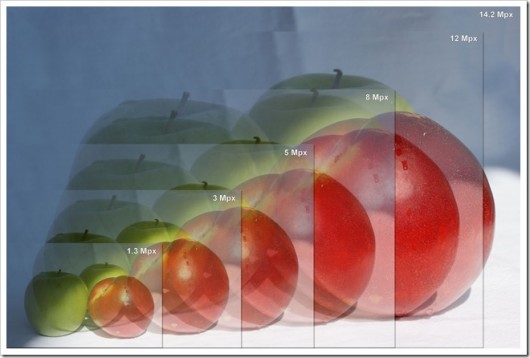
 Al comprar una cámara de fotos, la principal característica en la que nos solemos fijar es en la cantidad de Megapixels que tiene la cámara, empujados por la falsa creencia de que cuanto mayor sea este número, mejor es la cámara, propiciada en gran medida por la campaña de desinformación de la mayoría de las tiendas de aparatos electrónicos.
First of all, it would be useful to know what a pixel and a Megapixel are:
Pixel
It is the smallest homogeneous color unit that is part of a digital image, whether it is a photograph, a video frame or a graphic.
By sufficiently enlarging a digital image (zoom), for example on a computer screen, the pixels that make up the image can be observed. Pixels appear as small squares or rectangles in color, black or white, or shades of gray. Images are formed as a rectangular array of pixels, where each pixel forms a relatively small area with respect to the total image.
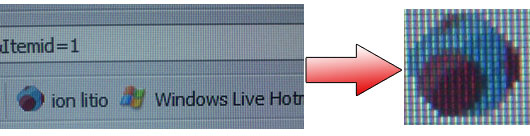
“Pixels on an LCD screen”
Megapixel
One megapixel or megapixel (Mpx) is equivalent to 1 million pixels. This unit is usually used to express the image resolution of digital cameras, for example, a camera that can take photographs with a resolution of 2048 × 1536 pixels is said to have 3.1 Megapixels (2048 × 1536 = 3,145,728).
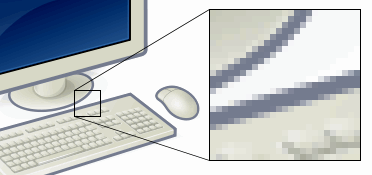
“Pixelized image”
Conclusions
In short, the MegaPixels of a camera only influence the size of the photographs it is capable of taking, not their quality. Therefore, in the case of wanting to take home photographs, to view them on the computer screen or to print them on standard-sized photographic paper, 3 MegaPixels would be more than enough, since they would take photographs at a resolution of 2048 × 1536, much higher than the normal resolution of any current screen, whether laptop or desktop.
You may be thinking that a photograph taken with a 2 Megapixel mobile phone does not have the same quality as its equivalent taken with a camera, and the thing is that, as I say, the importance of megapixels is rather nil and other factors, such as optics and the sensor, (among others) have more influence.
To be brief, the sensor determines the camera’s perception of color, and the greater the perception, the greater the detail. For its part, optics represents more or less 55% of the final quality of a photo. A glass lens from a well-known manufacturer (Leica, Carl Zeiss, Schneider, etc.) will always be better than a plastic one.
Maybe one day I will delve a little deeper into cameras, or not.
| Sources | Nova Blog | Wikipedia | At the counter |
|---|
Comments are provided by Disqus. When you load them, Disqus may use cookies and process data such as your IP address.
Disqus privacy policy