
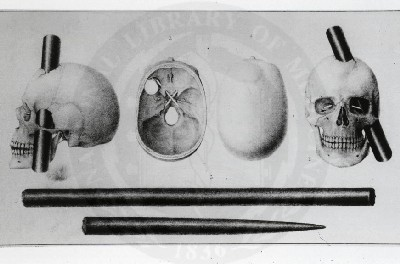
The case of Phineas Gage is known among the medical community as one of the most surprising studies on the influence of the brain on emotions.
This man worked in the Rutland and Burlington Road railway construction, was 1.65 m tall, weighed 63.75 kg and was 25 years old, when one of the most notable incidents recorded in the annals of medicine occurred to him. Phineas had a muscular build and was well liked by everyone, due to his good character and his efficiency when working, he was, in short, an affable guy.
The drilling process consists of slowly introducing dynamite into the stone with the help of an auger (hence the name) until once inside it can be detonated remotely. This was what Phineas Gage was about to do when, due to a distraction from his companions, the drill he was holding pressed the dynamite, making it explode, and projecting the drill (weighing 6kg and one meter long) towards him, since the hole drilled in the rock itself acted as a rudimentary cannon. It entered Phineas’ skull below his left eye, crossed his left frontal lobe and came out through the vertex of his head.
However, Gage, fully conscious and to the astonishment of his companions, asked to be transported, in an ox cart, to a nearby hotel where Doctor Harlow was staying, who upon seeing him described it as “fabulous”.
Harlow was not a notable doctor, although he was not mediocre either, he was simply an ordinary man who is remembered for an extraordinary event. After thoroughly examining Gage, checking the dimensions of the wound ** (the hole in the skull was 9 cm in diameter) and even inserting his index finger into the hole ** (human beings are curious by nature), for lack of a better idea, he applied dressings and bandaged the wound. Two weeks later, and still to his amazement he had no choice but to discharge him, a month later Phineas Gage was walking calmly through the city.
The medical interest lies in the fact that, despite his prompt recovery, he suffered a radical personality change, so much so that he was fired from the railway company and never found a stable job again, passing through several farms and a circus, where he exhibited the drill bit and the scar on his head. Harlow maintained that it was not his intelligence that was affected, but his emotionality and personality.
Before the explosion, Gage was considered efficient and capable. He seemed balanced, and people appreciated him for being hardworking, punctual and very sensible.
But after the accident, Harlow described him in the following way: “impulsive, irreverent and sometimes indulges in the crudest profanities (which was not usual for him before), showing very little respect for his companions; he does not tolerate restrictions (…), capricious and indecisive…”.
Phineas Gage died twelve years later from an epileptic seizure. His skull and auger are preserved in the Harvard Medical Museum.