
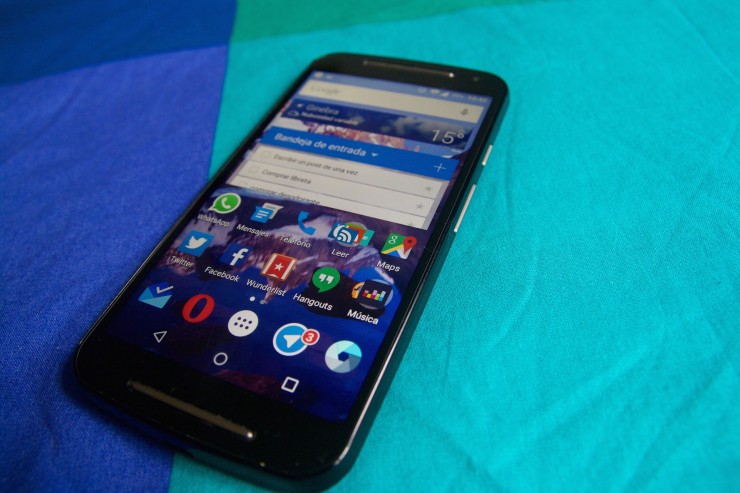
A few months ago my iPhone decided that it was tired of connecting to data networks and that 6 hours of battery life was more than enough. “Shit,” I thought. I didn’t feel like changing my phone because this one, despite everything, worked perfectly. Furthermore, I didn’t feel like making a big outlay on something that I barely used to send a few messages, read some blogs, social networks and little else. What could I do?
First of all, it seemed logical to me to think about what I really needed taking into account the use I give to the phone.
- Read blogs using their RSS.
- Social Networks: Twitter and Facebook.
- Take photos from time to time and record videos.
- Browse the Internet.
- Watch videos. -Google Maps.
- Instant messaging: Telegram, Whatsapp, Hangouts.
- Task managers: Wunderlist.
- Calendar.
- Contact managers.
- Notes manager: Google Keep and Evernote.
- Listen to music: Spotify, Google Music, Deezer…
It’s not much, right? After much deliberation, I opted for a Moto G 2014 LTE (the latter by mistake, since I didn’t know that there was a 4G model and a 3G dual sim model, which would have been great for me).
The fact is that this phone seemed to perfectly meet my expectations: it was “relatively” powerful, its screen was not huge for those of us who come from a 4” phone and I was not going to use it for overly demanding tasks.
Delusional of me, it seems that the concept I have of power user is already outdated, obsolete. Although I thought that all the tasks listed above were the minimum that any user could ask of a phone today, my brand new mobile phone did not think the same and warned me through numerous freezes when the music was playing in the background while I was reading some posts on Feedly.
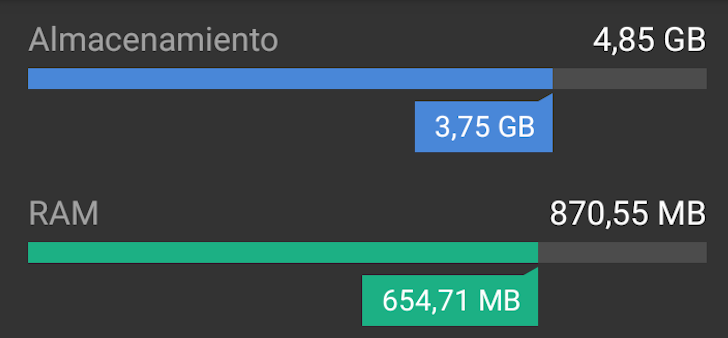
At that moment (And when I realized that the phone had 70% continuous RAM consumption and about 3.5GB free of 5.85) was when I realized that perhaps the phone was going to fall short.
1GB of RAM, 8GB of internal storage and a 16GB SD card. The same memory as my iPhone 5 and a little less storage than the same. What was happening in there?
That’s when I started looking for a way to solve mobile phone problems. The first thing I did was download Greenify, an app that puts applications into hibernation in the background to prevent them from consuming RAM. When I thought it was installed and that I wouldn’t have to do anything else, I discovered that the application, to work correctly, had to have root permissions, so I had to read a few manuals to learn how to do it.
Later I also learned that to be root you had to unlock the bootloader, which voided the device’s warranty. Brilliant.
This is Android, gentlemen.
Unfortunately, after taking these measures the problems continued and that was when I read in a forum that apparently it is a fairly common problem of the terminal, which does not manage memory well.
To recapitulate, I had a recently purchased mobile phone that was not suitable for what I wanted, but should have done without problems and for which I had already voided the warranty, so I had no possibility of returning it. It was time to continue looking for solutions.
If I had little space in the internal memory and on top of that the phone managed memory poorly, everything pointed to the fact that a change of ROM - one of the things I did not want to do when I bought the phone - could be the solution, so I opted for AOSP (Android Open Source Project) because it was a supposedly light ROM that would only include the basics.
It lasted me a day.

Just because it was light didn’t mean it was robust. Problems connecting the phone to the computer and this being detected one out of every three times, together with other problems that I don’t remember, made me back away.
Next stop? Check the XDE developers forums to see if I found another ROM that fit my needs. The result? Cyanogenmod.
After several installations of different custom recoveries I managed to install Cyanogenmod from the nightlies (another new term to add to the dictionary) on its official website. Since then, it is the ROM I use and everything works - apparently - correctly. I’m still having the same issues with free space, but it seems like the memory management issues have been fixed and the system is not crashing. Cross your fingers and hope it lasts.
After all this nonsense, it is worth asking what a user without knowledge of this type of matter would have done in a situation like this. Is Android really an acceptable platform for the most basic users or have I been the one who was being optimistic by buying a mobile phone that supposedly falls short of the standard? Is it worth spending 500 euros on a phone that will only last 2 or 3 years until you have to change it? Do we users have an alternative?