
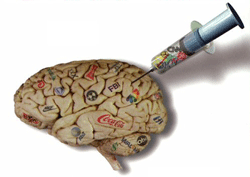
I have been seeing the word “meme” on the internet for a long time, but the truth is that it was not until yesterday when I decided to look for its meaning, its origins and what it consists of.
What is a meme?
According to eCuaderno:
“Memes are original, useful or funny ideas, whose appeal makes people adopt them and share them with others.”[…]A meme can be anything from a joke to a business, through a useful application, a community project, an urban legend, a contest or a game.[…]
So, I think a meme could be practically anything you see on a blog or website and decide to adopt for yourself. An example of a meme that I made a long time ago without knowing it, could be considered “My 10 favorite video games”, which I had previously seen on IonLitio.
The truth is that its description reminds me a little of chain messages, only in this case only the best and most interesting survive (Or at least they should), plus they do not reach your email in the form of spam.
Where does the word meme come from?
Meme is a word created from modern theories of the transmission of culture (which, contrary to what some think, does not come from “memez”), and is the minimum unit of transmission of cultural heritage. The creator of the word was Richard Dawkins, a professor at the University of Oxford specialized in scientific dissemination.
It bears a certain similarity to the word gene (Minimum unit of transmission of biological inheritance), and comes from synthesizing the words “memory” and “mimesis” (Which in Greek means “imitation”).
How to stop them?
Trying to stop memes is just as impossible a task as trying to stop the spread of culture. Don’t even try.
Some examples of memes:
- The songs meme: The great playlist meme of ‘04
- The cities meme: My 2005 in cities
- The teacher meme: Activities and resources that work
- The meme of the phrase: Grab Book Page 23 Sentence 5
- The meme of strange habits: Cinco manías
- The IBSN meme: Internet Blog Serial Number
- The meme of influences: Thanks, tributes and nostalgia
- The personality meme: Your personality summarized in 26 links
- The Fridays meme: Friday five
| More information: eNotebook | Memes: The viruses of the mind |
|---|
| Wikipedia | Meme Wikipedia | Richard Dawkins |
|---|