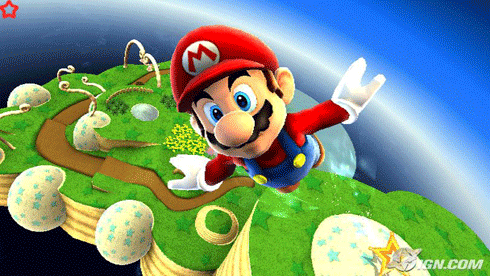

It was 1981 when the Nintendo factory released the first game featuring the plumber in red overalls, and which a few years later would become the company’s flagship symbol. But, at that time, he was neither a plumber nor was his name Mario. It was Jumpman. This is the story of its evolution.
Shortly after, this plumber got rid of “Donkey Monkey” (Also known as Donkey Kong) to embark on a solo career, and it didn’t take him long to achieve great success with games like Super Mario Bros for NES. The game plan was simple. It was simply a matter of advancing through 2D levels avoiding enemies and cliffs to reach the end of the phase. A simple and fun design, which gave many people a great time and also provided a good injection of income for Nintendo.
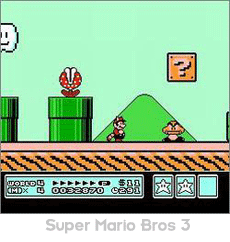
Ignoring Super Mario Bros 2, which is a game that I never liked and that I think should not be considered part of the saga, since it was originally designed for other characters, who were later replaced by the entire Mario “family”, the arrival of Super Mario Bros 3 revolutionized the world of video games even more, since it offered, on the one hand, the same as its predecessors: a simple concept. But just because it was simple doesn’t mean it didn’t have new features, since it did. The graphical complexity of both Mario and the scenarios was significantly improved, while new “artifacts” such as the raccoon’s tail or the flute were included. Improvements that did not increase the complexity of the game, but rather made it more varied.
The topic looked good. Nintendo realized that the magic formula worked perfectly, that there was no reason to change it, and that was the case throughout the 16-bit reign (Apart from the fact that the consoles of that time could not offer much more of themselves).
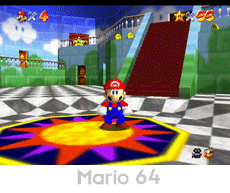
And the “revolution” arrived. Nintendo presents its brand new Nintendo 64 along with a game, the first fully 3D platform: Mario 64. Although its title was not the most original in the world, the approach of the game, as well as its visual quality, its control, etc., did not disappoint anyone, even going so far as a specialized magazine, such as Hobby Consolas (which at that time was a good magazine) did not rate it because “it was an unspeakable wonder.” I wasn’t disappointed either, but looking back, I wonder if it was really worth it. Mario, famous throughout the world, and known for his easy-to-play video games, abandoned his 2D for a complex 3D world, considerably increasing the difficulty and the concept of platforms. The concept of “jump and don’t fall” had disappeared.
The same thing happened with Super Mario Sunshine. The platform concept was maintained, but new elements were incorporated that, while making the game more varied, made it more complex and different from all its predecessors, which was reflected in the criticism of experts and the general public. It could be said that this game moved even further away from the simplicity of the classic Marios, making it a “less Mario” game and adding features such as having to hose down an entire city, something that generally did not convince.
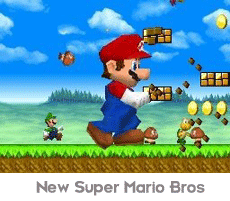
It was the release of New Super Mario Bros for Nintendo DS that broke all expectations, placing it at No. 1 on the list of best-selling games for months. The reason for this success? The simplicity. People are tired of complex 3D games that require hours to get the hang of, and it’s proven that simplicity is what’s making the DS victorious in the portable market. It is proven that you don’t have to be nostalgic for 2D platforms to like a game of this type, and that many people are attracted to them precisely for two reasons: the first is simplicity, and the second is speed. Speed is understood as being able to play a quick game whenever we feel like it, without having to wait 5 minutes for a level to load.
In 2008 or 2009 the new entry in the saga will go on sale: Super Mario Galaxy, and the question is clear. What path will Nintendo follow? Place your bets.