
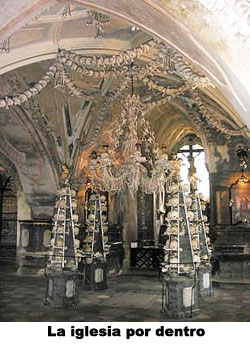
Located in the town of Kutna Hora, in the Czech Republic, 90 km from Prague, the Kostice church is the largest ossuary (place for collecting bones) in the world. What makes this church peculiar is not that bones are kept inside it, but that it is decorated with them. It is the remains of 40,000 people that make it possible for the church to remain standing, and, as is generally the case in these cases, its history is dotted with legends. According to legend, in 1142, a nobleman named Miloslav, traveling from Prague to Moravia, stopped to rest in the forests around Kutna Hora. He felt so tired that he couldn’t help but fall asleep and dreamed that a bird entered his mouth and whispered to him that he should build a monastery right there. The nobleman, convinced that more than a dream, this had been a divine revelation, did not hesitate for a moment and began to build the church. Next to it, he also built a cemetery and invited the Cistercian monks from the nearby city of Waldsassen to manage it all.
 En 1278, el abad Jindrich fue enviado por el rey bohemio a Jerusalén, de donde trajo un puñado de tierra del Gólgota y la dispersó por la tierra del cementerio, bendiciéndola así de alguna manera. A raíz de eso, toda la gente quería ser enterrada en ese cementerio ya que creían que el alma de quién descansara allí estaría en el cielo en un día.
The influx of corpses from the cemetery was enormous, since it had achieved enormous fame and they even buried people from other countries. Everyone wanted to be buried in Sedlec. It was the plagues and the Hussite wars that caused the cemetery to grow in an exorbitant manner, even occupying an area of 3 hectares, with more than 30,000 people buried, including the 500 Cistercians killed when the Hussites burned the monastery.
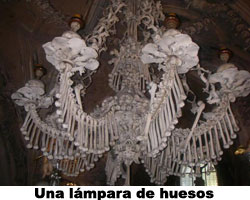 El cementerio se había quedado pequeño, y los huesos comenzaron a apilarse alrededor de la iglesia. Más tarde, comenzaron a introducirse en la parte inferior de ésta, hasta que en 1511, un monje medio ciego formó 6 pirámides con ellos ya que comenzaba a no quedar espacio dentro de la iglesia. Aunque fue en el siglo XIX, cuando el Príncipe de Schwartzenberg, preocupado por la cantidad de huesos en el lugar, contrató a Frantisek Rindt, un afamado artista local, para que mejorase el lugar respetando a la vez el deseo de las personas que decidieron que sus restos descansasen en el lugar.
From that time on, the church became known as Kostnice, Ossuary. And, although since the end of the 14th century it has suffered from construction defects (an inclination similar to that of the Tower of Pisa), it is visited by more than 150,000 people a year. Furthermore, a curious fact is that the number of people buried there exceeds the number of inhabitants of Kutna Hora several times.
Without a doubt a good place to spend the summer holidays :D